


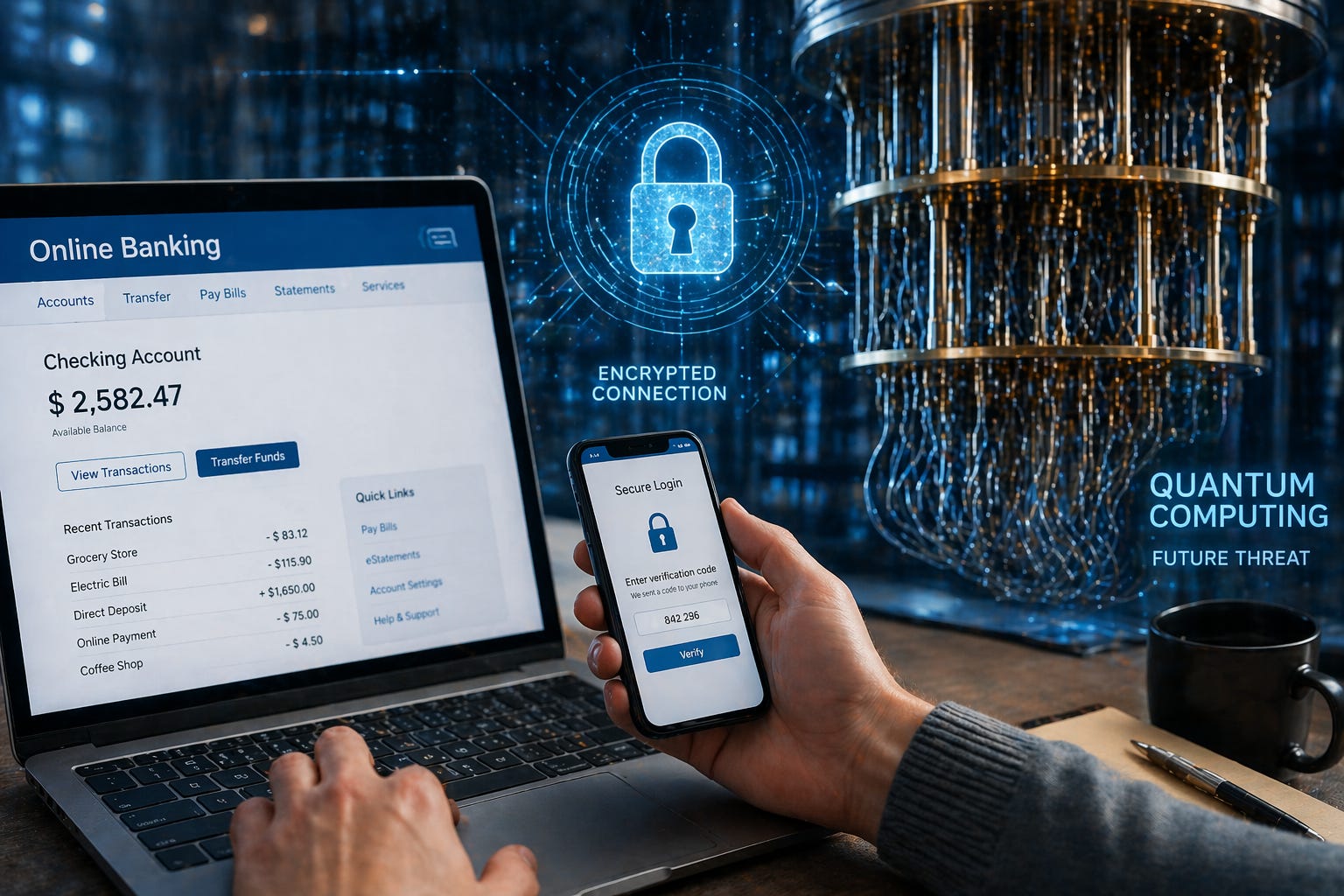
When people hear about quantum computing, the conversation often turns to Bitcoin. Could a powerful enough machine break its cryptography? Could digital assets be stolen? But there is a more immediate and less discussed question: what about your everyday bank account?
If quantum computing ever becomes capable of breaking modern encryption, your online checking account would not be exempt. In fact, in some ways, it could be just as exposed.
Today, banks rely on many of the same cryptographic tools that secure the broader internet. When you log into your account, your connection is protected by protocols like TLS, which depend on public key cryptography. Behind the scenes, systems use algorithms such as RSA and elliptic curve cryptography to secure logins, transactions, and communications between financial institutions.
These are the very systems that quantum computing threatens.
A sufficiently advanced quantum computer could use Shor’s algorithm to break these encryption schemes, allowing an attacker to decrypt sensitive data or impersonate a trusted party. In theory, that could mean intercepting login credentials, forging transactions, or accessing private financial records.
But as with Bitcoin, the key phrase is “sufficiently advanced.” That level of quantum capability does not exist today. There is no evidence that any institution, government or otherwise, has a machine capable of breaking modern banking encryption in real time.
Still, the concern is not hypothetical in the long run. Security experts have been warning for years about what is called “harvest now, decrypt later.” The idea is simple. An attacker could collect encrypted financial data today and store it, waiting for the day when quantum computers are powerful enough to decrypt it. That does not require breaking systems now, only preserving the data for future access.
Banks and governments are not ignoring this risk. Standards bodies like the National Institute of Standards and Technology have already begun rolling out new forms of encryption designed to resist quantum attacks. Financial institutions are actively researching how to transition their systems to these new standards, though the process will take time. Unlike a simple software update, upgrading global financial infrastructure requires coordination across thousands of institutions and legacy systems.
There is also an important difference between Bitcoin and traditional banking when it comes to risk. If a vulnerability were exploited in Bitcoin, the burden would fall heavily on individual users to secure their funds and move them to safer systems. In contrast, banks operate within a regulated framework. They have security teams, insurance mechanisms, and, in many cases, government backstops. If a breach occurs, customers are typically not left to absorb the full loss.
That does not mean the system is invulnerable. It means the responsibility is distributed differently.
Your online checking account is protected by layers of security beyond cryptography. Multi factor authentication, fraud monitoring, transaction limits, and human oversight all add friction for attackers. Even if encryption were weakened in the future, these additional controls would still play a role in limiting damage.
The bigger challenge is time. Financial systems are vast and complex, and transitioning them to quantum resistant encryption will not happen overnight. The risk is not that your bank account will suddenly be drained tomorrow by a quantum computer. The risk is that institutions must complete a slow and careful migration before the technology reaches a tipping point.
For consumers, there is little immediate action required beyond basic security hygiene. Use strong passwords. Enable multi factor authentication. Monitor your accounts. These steps protect against today’s threats, which are far more practical than quantum attacks.
The conversation around quantum computing should not be limited to cryptocurrency. It is a broader issue that touches every part of the digital economy, including the systems people rely on every day.
If quantum computing eventually reshapes cybersecurity, it will not just be a story about Bitcoin. It will be a story about the entire financial system adapting to a new kind of risk.
That’s why my UNTRACKABLE,UNCONTROLLABLE,PRIVATE,Buy from my neighbors anything I want with no taxes & No 1 else’s business GOOD OLD PAPER NOTE or even Gold❤️💪🏼