


In the first piece in this series, I argued Mississippi should welcome the data-center boom. I stand by that argument. But I would not make it honestly without addressing the environmental concerns directly. Conservatives do ourselves no favors when we pretend every environmental concern is imaginary or anti-growth. Some of the concerns are real, and we lose credibility when we refuse to admit it. We are supposed to be the people who can tell the difference between a real problem and a manufactured one. So let me try.
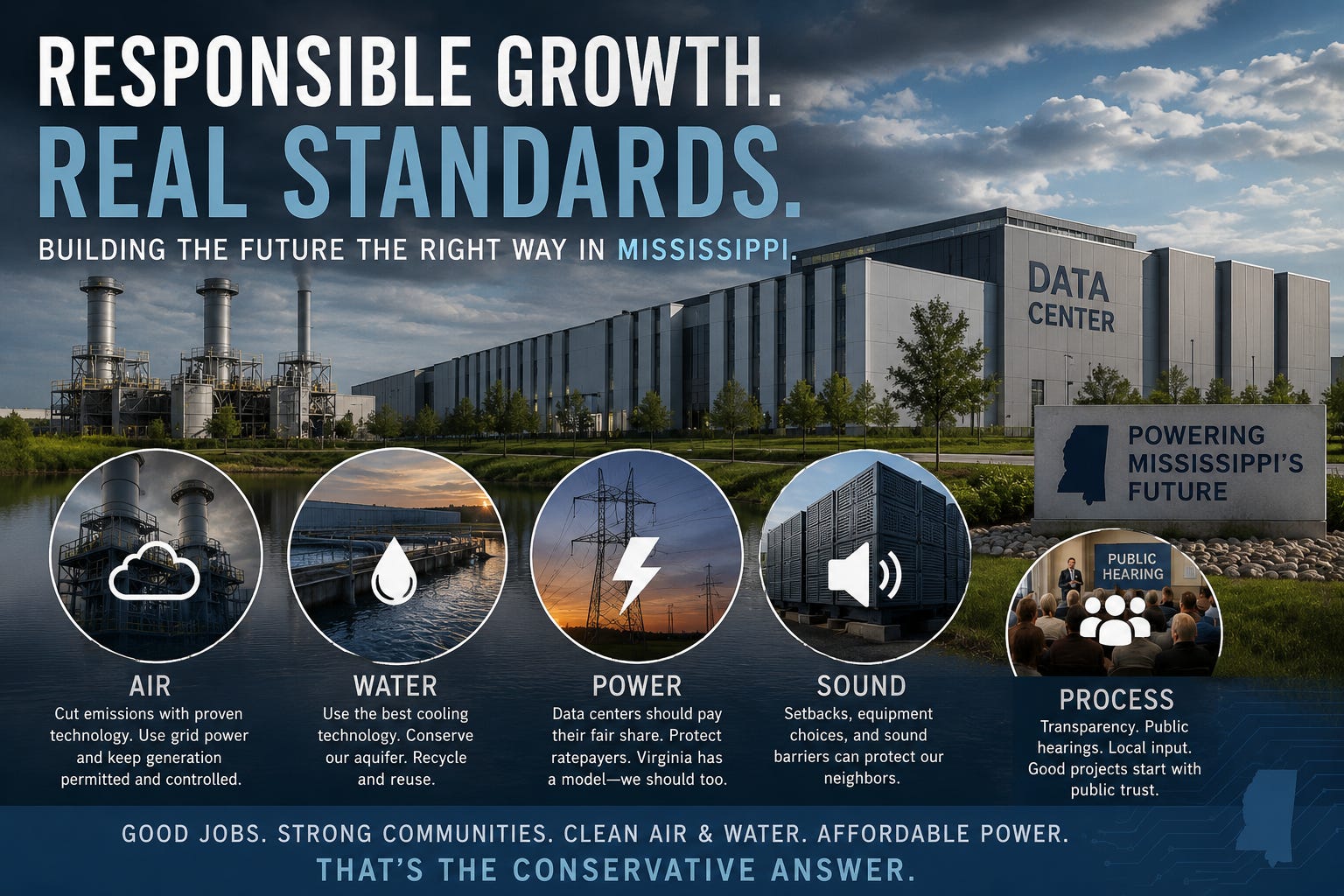
Three concerns matter most: air, water, and the electric grid. A fourth — sound — matters in a smaller way that locals near the sites already know about. On each of them, the engineering exists to do this right. We just have to insist on it.
Start with air. xAI’s Southaven campus has been operating natural-gas turbines whose emission potential, on paper, includes more than 1,700 tons of nitrogen oxides, 180 tons of fine particulate matter, 500 tons of carbon monoxide, and 19 tons of formaldehyde per year. Those are the numbers in the federal lawsuit pending in the Northern District of Mississippi. Whether the turbines legally require permits is now a federal court dispute. Mississippi DEQ says the units qualify for a temporary-mobile exemption; environmental groups argue federal law overrides that interpretation. A judge will sort that out. But the larger engineering point remains: we already know how to reduce these emissions dramatically. Selective catalytic reduction cuts nitrogen-oxide output by about 90%. Oxidation catalysts cut formaldehyde and carbon monoxide. Better still is using grid power and putting any new generation on a permitted, controlled site instead of running uncontrolled turbines next to a neighborhood. EPA’s recently finalized emissions standards for combustion turbines push the industry in that direction as well. Mississippi should too.
Water is next. Memphis sits on the Memphis Sand Aquifer, our drinking water. The concern that hyperscale cooling systems could draw enormous amounts of water from the aquifer is real. The good news is that the cooling industry is moving fast. Closed-loop and direct-to-chip systems can reduce water use by up to 91% compared with old evaporative cooling. Microsoft is piloting a zero-water cooling design at new sites in Phoenix and Wisconsin. xAI and MLGW broke ground last fall on an $80 million greywater facility designed to recycle 13 million gallons per day and save five billion gallons of drinking water annually. None of that is theoretical. We should require it as a condition of operating in Mississippi, not hope for it.
Electric power is where conservatives have the most leverage and the strongest case. Data centers are huge new loads on the grid. If utilities build new substations, transmission lines, and generation capacity for those facilities and then spread the costs across ordinary ratepayers, Mississippi families end up subsidizing trillion-dollar corporations through their utility bills. Mississippi Power has reportedly delayed retiring older coal plants until the mid-2030s in part because of new data-center load. That is a cost. Virginia has already started addressing this problem: a new “GS-5” rate class that requires data-center customers to pay collateral up front and absorb their own grid-upgrade costs. If a data center leaves or scales back operations, ordinary ratepayers are not left holding the bag. Mississippi should adopt the same idea — and we don’t need a federal mandate to do it. Mississippi does not need Congress to solve this. Mississippi does not need Congress to solve this. The Public Service Commission already has the authority to structure rates so ordinary families are not left subsidizing hyperscale data centers.
On sound, the answer is mostly setbacks, equipment selection, and acoustic walls. It’s a real quality-of-life issue for neighborhoods near these sites — anyone who has lived next to a row of running gas turbines knows it is not a small thing — and it is the easiest of the four concerns to fix. Counties should write reasonable noise standards into the conditional-use approvals they hand out, the same way we already write them for poultry plants and asphalt batch plants. None of this requires a special agency or a federal mandate. It just requires the discipline to set the standards and enforce them.
There is one more piece, which is the question of process. A lot of the heat in Southaven and South Memphis is not really about the engineering — it is about people feeling that something massive was dropped onto their neighborhood without their being asked. That is a fair complaint. The fix is straightforward: real public hearings before construction, posted air-permit applications with enough lead time for citizens to weigh in, and county-level conditional-use review with real teeth. Conservatives believe in local government for a reason. We should not abandon the principle just because the project is exciting.
There is a temptation in our politics, on both sides, to pick a tribe and accept everything that tribe believes. The progressive who tells me a data center is automatically an act of environmental racism is asking me to ignore the engineering. The conservative who tells me an environmental concern is automatically a left-wing hustle is asking me to ignore my own eyes. I am not willing to do either.
The right answer for Mississippi is the conservative answer, properly understood: require industry to internalize the costs of its own pollution; require it to pay for the public infrastructure it consumes; protect the citizens who were here first; and let the projects stand on their own engineering and their own balance sheets. That is not anti-business. That is how grown-up business works.
In the next piece, I want to talk about the part of this issue that genuinely angers me, which is what Mississippi is paying these companies to come here, and why no real conservative ought to defend those deals.
I guess my concern is who will monitor these mega centers to be sure that this is handled to not harm taxpayers. Big money is behind all this and can easily slip into the back pockets of local officials to just look the other way. Will all this eventually be our demise?