


If you have read the first two pieces in this series, you know I want Mississippi to win the data-center boom. I think we should welcome it and stop apologizing for wanting investment in our state. That is the conservative case for data centers.
This piece is the conservative case against the way Mississippi is paying for them.
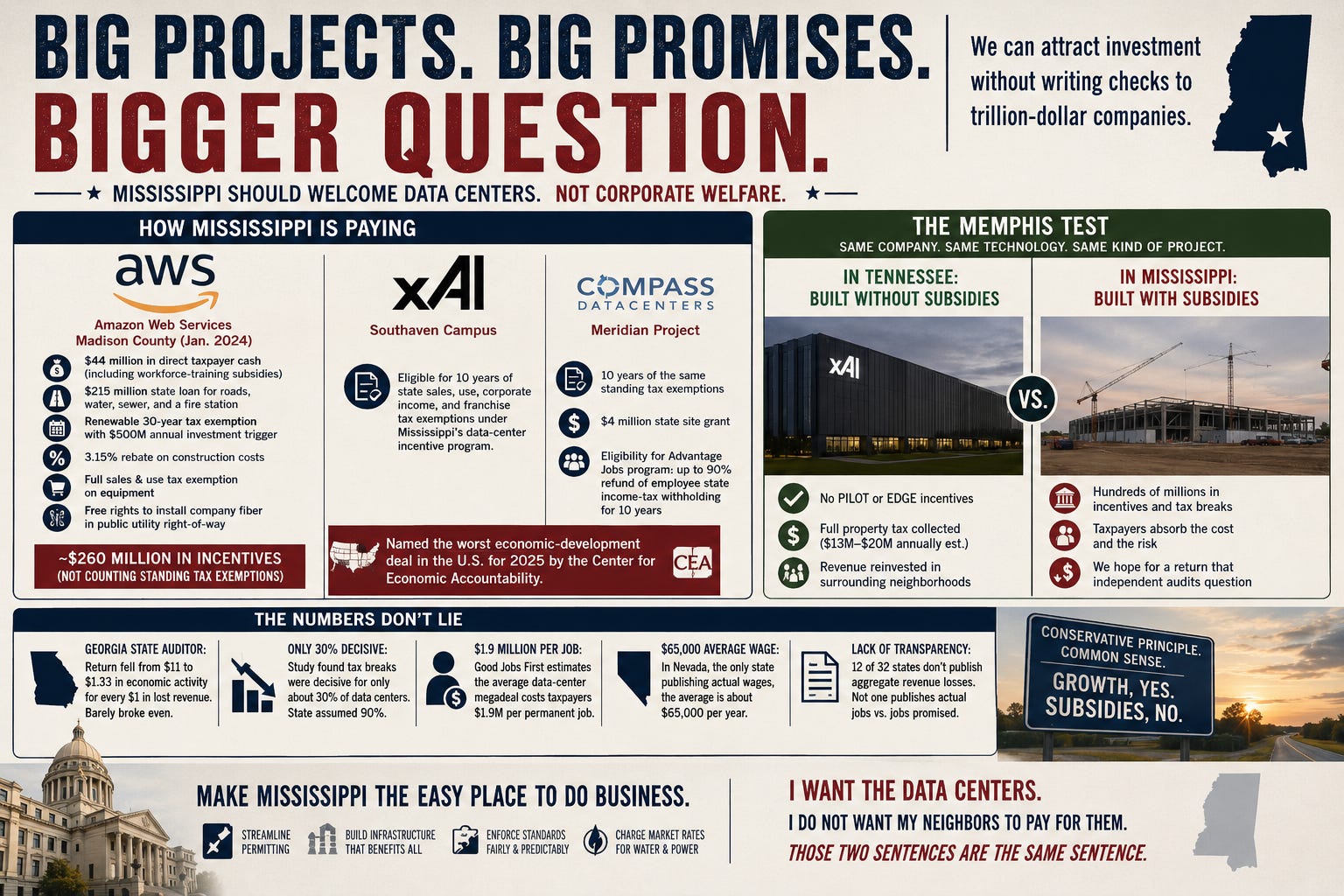
Let me say plainly what our state has done. In a January 2024 special session, the Legislature approved a massive incentive package for Amazon Web Services in Madison County. The package included $44 million in direct taxpayer cash, including workforce-training subsidies that shifted costs from Amazon onto taxpayers, along with a $215 million state loan for roads, water, sewer infrastructure, and a fire station. The deal also included a renewable 30-year tax exemption triggered by continued investment of at least $500 million annually, a 3.15% rebate on construction costs, full exemption from sales and use tax on equipment, and free rights to install company fiber in public utility right-of-way. The headline value of the package, not counting the standing tax exemptions, was roughly $260 million.
These are subsidies. Big, public, generational subsidies. They are not capitalism.
Then in April 2026, Amazon expanded its Mississippi commitment to $25 billion across additional sites, all of them eligible for the same standing exemptions.
Mississippi’s standing data-center incentive program, on the books since 2019, exempts certified data-center companies from state sales and use tax, corporate income tax, and franchise tax for ten years. xAI’s $20 billion Southaven campus falls under that program. Compass Datacenters’ $10 billion Meridian project qualifies not only for those exemptions, but also for a $4 million state site grant and eligibility for the Advantage Jobs program, which can return up to 90% of employee state income-tax withholding back to the company for ten years.
The Center for Economic Accountability, an independent watchdog group focused on subsidy policy, named the Compass deal the worst economic-development deal in the United States for 2025.
The argument we are constantly given is that the state will eventually earn this money back through economic growth. I would like to believe that. But independent audits do not back it up.
When Georgia’s own state auditor analyzed what else the state could have done with the forgone tax revenue from data-center incentives, the return collapsed from the headline claim of $11 in economic activity for every $1 of lost revenue down to about $1.33 for every $1 foregone. In other words, the incentives barely broke even, and only under the assumption that Georgia could not have used the same money more effectively elsewhere, whether on roads, schools, or returning it directly to taxpayers.
A separate independent assessment found Georgia’s tax exemptions were actually decisive for only about 30% of the data centers built there. The state had previously assumed the figure was 90%. In other words, many of those projects likely would have happened even without the subsidies.
Good Jobs First, one of the leading watchdog organizations tracking state subsidy programs, estimates the average data-center megadeal in America now costs taxpayers roughly $1.9 million per permanent job created. In Nevada, the only state that publicly reports actual permanent-worker wages for these projects, the average salary is about $65,000 a year, well below the figures commonly used in splashy press announcements. Of the 32 states offering data-center incentives, 12 do not even publish aggregate revenue losses, and not one publishes actual permanent jobs created versus jobs promised.
Here is the test.
xAI built its first Memphis supercomputer campus without taking a single PILOT or EDGE incentive from the State of Tennessee. Memphis is still collecting full property taxes on the project, estimated at roughly $13 million to $20 million annually, and reinvesting a portion of that revenue directly into surrounding neighborhoods through a community-benefit ordinance.
Same company. Same technology. Same kind of project. No subsidy.
That should at least force Mississippi taxpayers to ask whether these subsidies are actually necessary on our side of the state line.
A real conservative position on this is not anti-investment. It is anti-corporate welfare.
The state should make it easy to do business in Mississippi. Streamline permitting. Pre-approve industrial sites. Build infrastructure that benefits every industrial user instead of a single politically connected company. Enforce environmental standards fairly and predictably. Charge market rates for water and electricity.
That is what governments are for.
What governments are not for is writing checks to trillion-dollar corporations because we have convinced ourselves they will only come if we pay them to.
If a data-center project only works because taxpayers absorb the cost and the risk, it is not real economic development. It is a transfer from working Mississippians to shareholders in California and Seattle, dressed up in a press release.
I want the data centers. I do not want my neighbors to pay for them.
Those two sentences are the same sentence, and it is the one our governor, our Legislature, and our Public Service Commission ought to hear from every conservative in this state, loudly and often.
In the next piece in this series, I want to make the argument I find hardest to walk away from: Mississippi has been through this cycle before. The historical record is sitting right in front of us. We just keep choosing not to read it.
The thing no one seems to talk about is that even if the state *government* breaks even or comes out ahead on tax revenue, the individual *taxpayers* (us) are the ones paying that increased tax cost. And when the tax breaks to Nissan or Amazon or whoever finally end, they will leave the state for the next free ride. Conservatives love to complain about 'welfare moms', but seem perfectly happy with welfare corporations making billions of dollars and paying zero tax.
We are crazy to think that these data center build outs are here as our benefit and are to be a
savior for economic prosperity. I don't know it this is blindness by people who have not studied the issue, not understanding the tech, or never worked inside a data center. These are not fostering a large amount of jobs. Nor are they anything remote to conservatism. This must a boomer cult classic here that has developed. I am deep into tech, have my own company. Design, develop and deliver AI solutions. All decentralized. These data centers are not for families, small business, medium business, or non-profits. They are control grids for only large corporations and institutions. History will not be kind to those that push them as benign saviors bringing false economic prosperity. Or, pushing more and more centralization. Insane. Man, critical thinking is needed here by those that think this is such a great idea. The ppl are not with you on this topic or accepting a fraud being perpetrated. I vehemently reject this argument that this is good for Mississippi's citizens.