


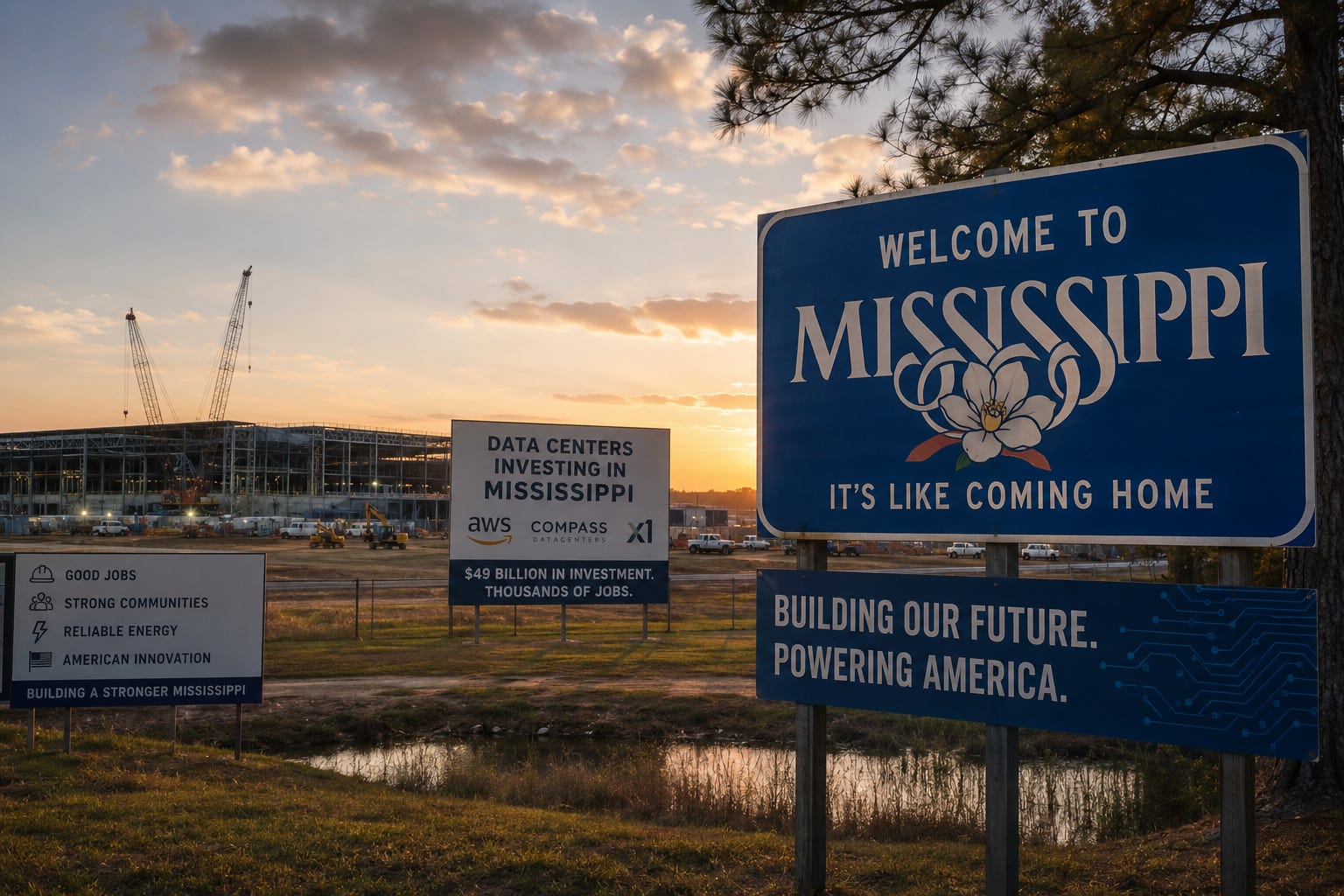
There is a quiet argument going on right now in coffee shops and county supervisor meetings across Mississippi. Some of my fellow conservatives have started treating data centers as the next big threat to Mississippi communities, convinced they are going to drain our aquifer, strain our power grid, raise electric bills, and leave behind nothing but fenced off buildings humming with servers. I understand the suspicion. I share some of it. But I think we are about to talk ourselves into a serious mistake, and I want to make the case for why we should not.
Start with the size of what is happening. The Electric Power Research Institute projects that data centers will consume between 4.6% and 9.1% of all electricity generated in the United States by 2030 — more than double their share in 2023. Goldman Sachs forecasts a 165% increase in global data-center power demand by the end of the decade. Whether you love artificial intelligence or roll your eyes at it, the build-out is real, and the money behind it is enormous. The only question is which states get the investment and which states watch it go to Texas, Georgia, and Virginia.
Mississippi has spent most of my lifetime watching tech investment go somewhere else. Now it isn’t. Amazon Web Services has committed $25 billion across multiple Mississippi sites. Compass Datacenters is building a $10 billion campus near Meridian. xAI announced a $20 billion campus in Southaven, the largest single private investment in the state’s history. Add the smaller projects and Mississippi has roughly $49 billion in headline data-center investment on the books. That is not a typo. By any measure, it is the largest wave of private industrial investment Mississippi has ever seen.
What does that buy us? Construction crews working five-to-eight-year build-outs. Permanent operating jobs that pay at least 125% of the average state wage. Substations, fiber, water and sewer lines that serve the data center but stay in the ground for the next industrial user too. And importantly, it creates enough new electricity demand to potentially improve the economics of the grid for everyone else — if we make sure data centers actually pay the infrastructure costs they create. That “if” matters, and I’ll come back to it in Part 2.
Conservatives ought to be careful about reflexively saying no to this. One of the oldest truths in economics and politics is simple: if you don’t build, somebody else builds, and you live in their world. The country that hosts the compute capacity for AI will set the standards for everything that runs on it — banking, defense, medicine, agriculture. We have spent four years arguing about TikTok and Chinese surveillance. The same logic that makes us nervous about Beijing controlling the apps on our kids’ phones makes me nervous about Beijing controlling the data centers that run the next generation of those apps. American compute belongs in America.
It is also worth being honest about who is doing the work during the build. A hyperscale data-center campus is not a quick six-month industrial park job. The Compass campus near Meridian is planned to be built out over eight years; AWS’s Madison County complex is on a multi-year construction schedule. That is electricians, pipefitters, concrete crews, ironworkers, truck drivers, and surveyors, putting steel in the ground year after year. We can debate how many permanent jobs ultimately stay local. What is not debatable is that the construction work is real, long-term, and already underway.
There is another argument I hear from neighbors that I take seriously, which is that the projects are being shoved down our throats with no public input. On that, the critics have a real point, but that is a different problem from the projects themselves. We can have public hearings, environmental review, and ratepayer protections without throwing away the investment. The fight over xAI’s gas turbines in Southaven is genuinely complicated, and the legal justification Mississippi DEQ used for its “temporary-mobile” interpretation is now being challenged in federal court. That is the regulatory process working the way it is supposed to work, even if imperfectly and slowly. It is not a reason to send the next $20 billion project to Tulsa instead.
And finally — this is the part the loudest skeptics tend to skip — the alternative is not a Mississippi where nothing changes. The alternative is a Mississippi where we keep watching our young people leave for Atlanta and Nashville, where we keep waiting for the next big employer to magically arrive, and where the AI economy gets built somewhere else by people who will charge us to use it. We have a real seat at this table for the first time in a generation. I would like to keep it.
In Part 2, I want to talk about the environmental concerns honestly, because some of them are right. In Part 3, I want to talk about how Mississippi is paying for these projects, and why a true conservative ought to be deeply skeptical of the deals our state is signing. Welcoming the boom and demanding it be done right are not contradictions. They are the same job.
The Real question all should be asking is: Are Data Centers a good idea? Understand: YOU are the data. Everything about YOU. YOU are the data. The purpose is to control YOU. ME. ALL OF US.
The real question is do the PEOPLE want this and do they comprehend the result of it. We can put the genie back in the bottle if the people unite! These “so called reps” do not re-present your wants people of America! With the current communication info structure there is no need to have government like this anymore. We can all express our demands of our servant government on our own.