


Last week I wrote about Walter Hunt, the man who invented the first sewing machine and was talked out of bringing it to market because his daughter worried it would put thousands of seamstresses out of work. The history that followed proved her fears wrong. The industry didn’t shrink. It exploded, and the women who would have been seamstresses found bigger work waiting for them on the other side of the machine.
I’ve been thinking about that story because I lived through a smaller version of it myself.
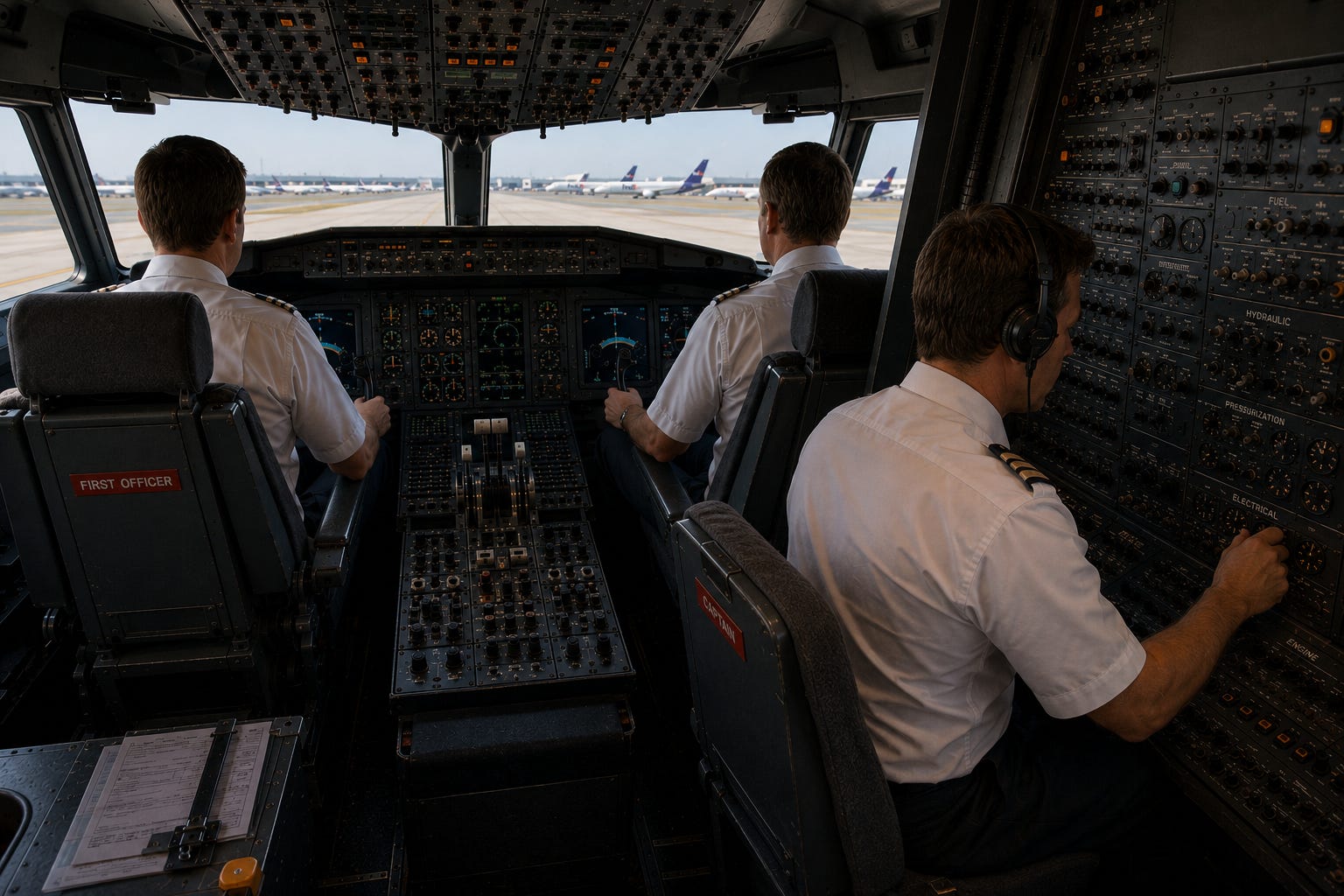
I started flying the Boeing 727 in 1998. By then the 727 was one of the last commercial airliners that still required a three-person cockpit, and I sat in the flight engineer’s seat — the panel turned sideways behind the captain, a wall of switches and dials for fuel, hydraulics, pressurization, electrical and engine systems. It was real, demanding work. You earned your keep on that panel.
Even then, everyone knew the job was going away. The 757, the 767, the MD-11 — all the newer airplanes had been designed for two pilots from day one. The computers had taken over what I was doing on the panel. The flight engineer’s seat was, in a literal sense, being designed out of the airplane.
When my time on the 727 panel ended, I moved into the right seat of the same airplane as a first officer, and then up into the two-pilot fleet. I have since flown the 757, the MD-11, and the MD-10 — and the MD-10 is the part of this story I think about the most. That airplane started life as a DC-10 with a three-person cockpit. FedEx pulled out the flight engineer’s station and rebuilt the cockpit so it could be flown by two pilots and share a crew rating with the MD-11. They took a perfectly good airplane and surgically removed the job I used to do.
Today I am a captain on the 767. The seat I started my career in does not exist on any airplane I have flown since.
And here is the part worth saying out loud: the industry did not shrink. Aviation has grown almost without interruption for my entire career. There are more pilots flying today than when I started. There are more airplanes, more routes, more freight, more passengers. The flight engineers I trained with became first officers and then captains. The people who would have been flight engineers in a different generation became pilots, dispatchers, instructors, maintenance controllers. The work moved. It did not vanish.
The same thing happened to the railroad fireman a generation before me. The diesel engine didn’t need anyone shoveling coal, and after a long fight the job ended. The trains kept running. The men kept working, most of them as engineers up front.
I tell this story because I am hearing a lot of fear right now about artificial intelligence. It is the same fear Caroline Hunt had about the sewing machine, and the same fear the locomotive firemen had about the diesel engine, and the same fear my own union once had about the two-pilot cockpit. It is an honest fear. It is usually wrong.
I seat I began my career in disappeared, but I gained the seat at the front of the airplane. That is what change has almost always looked like, if you stay in your seat long enough to fly through it.
Your article last week led me to write this Facebook post. I started doing research work with AI around 1988 or so. I left Kodak and went to work for the startup that was one of the first companies to commercialize AI. Thought you might like to see this.
------
Due to my work the last 20 years or so of my carrier being associated with the very early commercial applications of what is currently called AI, I have had several discussions recently with people concerned about what the technology will mean to our workforce. I have used the example of the internal combustion engine as an example of how technology has changed the world for the better. There are hundreds of examples of this fact, but think about IC engines. Someone figured out how to make power with fuel. Then it was applied to transportation. Then someone else applied it to farm equipment.
In 1900 approximately 40% of the US population were farm workers. Today statistics vary a little but from 1 - 2% are farm workers. I live on the farm where I grew up and we do farm it in that we are growing pine trees where Hereford cattle used to graze. When I was growing up in the 1950s and 60s, we spent a huge amount of time growing and preserving the food for our family. My grandparents, my parents, and my brother and I spent hours tending the garden plots and caring for the cattle, hogs, and chickens that provided our food. I don't do that now. None. Others here still do but they don't do it to survive. They do it for quality and because they love to do it.
Today a vast majority of the US population lives in cities and towns and not rural areas. These people are employed doing jobs that were never heard of as little as 50 years ago. If someone had told me in 1975 that I would be living on the banks of Bibalupta Creek where I grew up, implementing AI control and optimization systems, I would have thought they were crazy since I had no idea what AI was in back then. In 2007 that is exactly what I was doing when I moved back to Mississippi.
I just read an article written by Dana Criswell that inspired me to write this post. Mr. Criswell outlined a decision by an inventor, Walter Hunt, who had built the first working sewing machine. Mr Hunt was an interesting man. Take a look at his history. He was a prolific inventor and a brilliant mechanical engineer. He did not patent the sewing machine and bring it to the market because his daughter asked him not to due to it replacing the women who sewed by hand to make the clothing of the day. Fast forward and the US garment industry flourished after the sewing machine was put into production. It could be argued that it was not good work but it was better that doing all that by hand and employed more people. His daughter only saw part of the story. I would guess very much like those here in rural Mississippi that I heard say the demise of the family farm would ruin the US.
Today many are making the same arguments about deploying AI. People will loose their jobs. Yes, but history shows that when technology is applied, innovation leads to new professions that are more lucrative and rewarding that those that were replaced. New jobs will be created. Each of you can speak to a dozen jobs that once were done manually where now technology has provided either better ways to do the work or done away with the work completely. Just for the record I am very pleased that I never made a living plowing a mule and planting and picking cotton. I did it but not as a professional. Praise the LORD.
I would suggest that those of you who are interested do some reading on the AI technology to understand what it does, how it works, and how it will be useful. My experience tells me that the more you know about a topic, the less concerned you will be.
If any of you want to discuss this further give me a call.
Great article Dana!