


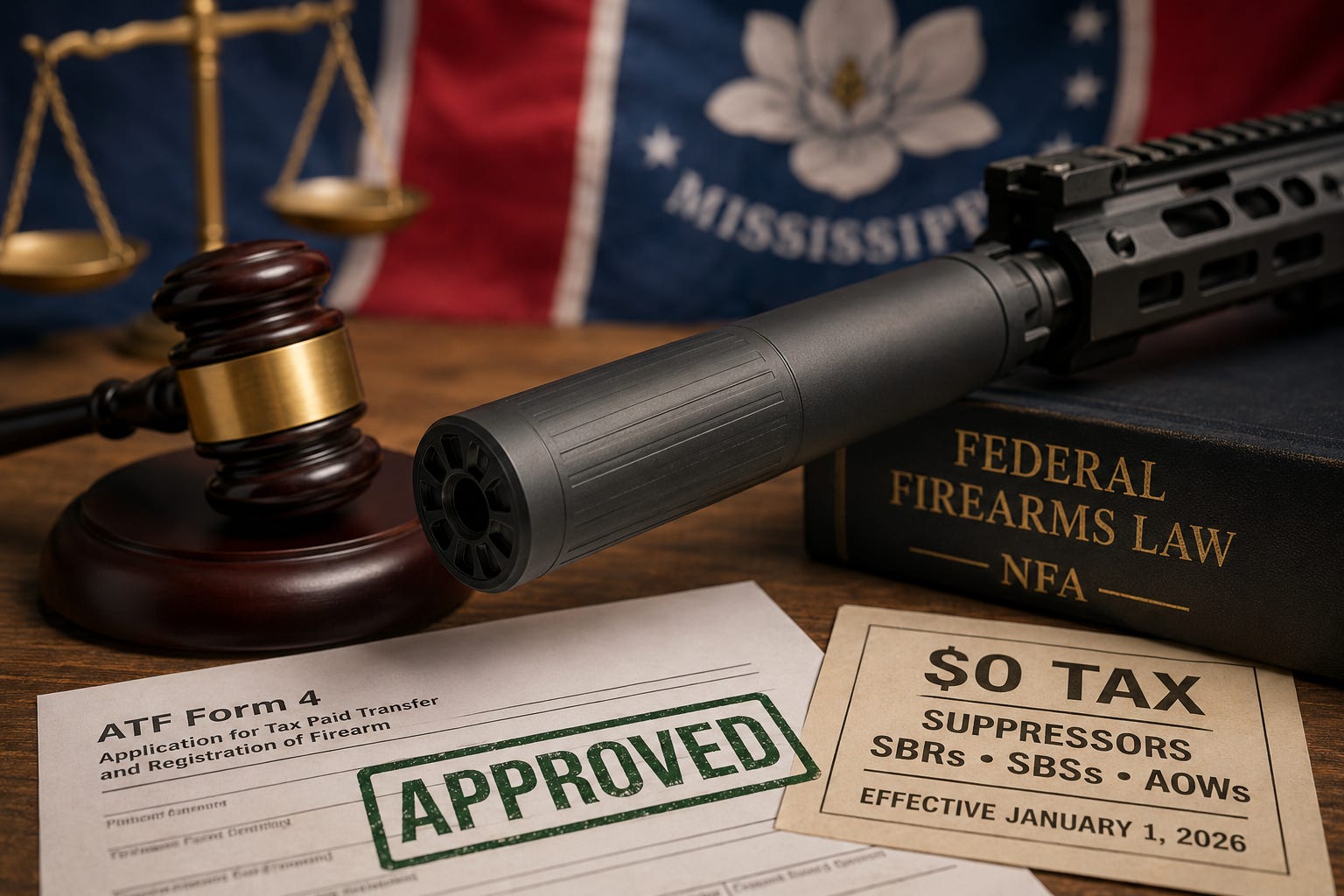
If you follow firearms news, you have probably seen the headlines: “Suppressors deregulated.” “The NFA is dead.” “No more tax stamp.” Some of it is true, some of it is oversimplified, and almost none of it explains what any of this means for someone living in Mississippi. Here is a plain-language walk through what happened in 2026 and what the law actually says today.
The old system
For roughly ninety years, certain firearms and accessories have been governed by the National Firearms Act, or NFA, a 1934 law. The NFA doesn’t ban these items; it regulates and taxes them. The list includes suppressors (also called silencers), short-barreled rifles (SBRs), short-barreled shotguns (SBSs), machine guns, and a catch-all category called “any other weapons” (AOWs).
To buy one, a person historically had to file an ATF Form 4, submit fingerprints and photographs, pass a federal background check, pay a $200 tax, and then wait — often many months — for the ATF to approve the transfer. Only after approval could the buyer take possession. That $200 stamp and the registration paperwork were the defining features of NFA ownership.
What Congress changed
In 2025, Congress passed a budget law (Public Law 119-21) that reduced the NFA making and transfer tax to $0 for suppressors, SBRs, SBSs, and AOWs, effective January 1, 2026. Machine guns and destructive devices were left alone and still carry the $200 tax.
One important point that often gets lost: Congress did not remove these items from the NFA. An earlier version of the bill would have done exactly that, but the Senate parliamentarian ruled that the removal language couldn’t stay in a budget bill under the chamber’s rules. So what survived was only the tax reduction. On paper, the registration requirement and the Form 4 remained fully in place — just with a $0 price tag.
The court ruling
That tax change set up the legal fight that followed. On August 5, 2026, the U.S. District Court for the Northern District of Texas decided Silencer Shop Foundation v. ATF (consolidated with a case backed by the NRA and Firearms Policy Coalition).
The court’s reasoning is worth understanding, because it explains why the ruling exists at all. The NFA has always been justified as an exercise of Congress’s power to tax. The court held that a tax which collects no revenue is not really a tax — quoting an earlier Supreme Court decision, it noted that “an essential feature of a tax is that it produces at least some revenue. A tax set at $0 produces none.” With the tax gone, the court found, the registration-and-approval machinery lost its constitutional footing for the items whose tax had been zeroed out. It therefore struck down the NFA registration requirement as applied to suppressors, SBRs, and SBSs.
In short: because the tax on those items is now zero, the court said the government can no longer require the Form 4 registration for them — for the people the ruling actually covers.
The catch: who is actually covered
This is the part the headlines usually skip. Because of a 2025 U.S. Supreme Court decision that curtailed nationwide “universal” injunctions, the Texas court could only grant relief to the parties in front of it. The injunction bars the government from enforcing the challenged NFA provisions against the plaintiffs and, where applicable, their members, their customers, and the fifteen states that formally joined the case. It is not a nationwide ruling, and it does not automatically apply to everyone in the country.
Mississippi was not one of the states that joined the lawsuit. As a result, a Mississippi resident is not covered simply by living here; coverage would depend on being a member of one of the plaintiff organizations or purchasing from a covered dealer.
The government is letting the ruling stand
Ordinarily a decision like this would be tied up on appeal for months or years. That is not what happened here. The court issued its ruling with a seven-day stay, and that stay expired at midnight Central on August 13, 2026 without the Department of Justice filing an appeal. By declining to seek a longer pause, the Trump administration allowed the ruling to take effect, and the first lawful transfers of unregistered suppressors reportedly took place that same morning.
The administration has also signaled it does not intend to fight the decision at all. Representative Andrew Clyde of Georgia said he “received confirmation from the Trump Administration that the DOJ will NOT appeal.” The DOJ itself has not issued a formal public statement, so the strongest evidence is the government’s own conduct — declining a stay and letting the deadline pass — together with that confirmation relayed through Congress.
Two caveats keep this from being fully settled. First, letting the short stay lapse is not the same as the appeal window closing entirely; under the normal federal rules the government has roughly sixty days from the August 5 judgment — into early October 2026 — to change course and file a notice of appeal. All indications are that it will not, but that window technically remains open. Second, because the relief is party-limited, the ruling does not, by itself, extend to Americans who were not part of the case. There is ongoing discussion in Congress and at the ATF about whether to broaden the relief so it applies nationwide, but unless and until that happens, the geographic patchwork remains.
What still applies everywhere
Even where the Form 4 requirement has been lifted, several things did not change. A buyer still completes a standard Form 4473 and passes a NICS background check through a licensed dealer. People legally prohibited from owning firearms still cannot buy these items. State-law bans and restrictions still control. And machine guns and destructive devices remain fully regulated under the NFA, $200 tax included.
Current Mississippi law
Mississippi’s own statutes matter as much as the federal ruling, and here the picture is specific.
For suppressors, Mississippi Code Section 97-37-31 makes it a misdemeanor to make, sell, or possess a suppressor unless the person is “duly authorized under federal law.” In plain terms, Mississippi ties the legality of a suppressor directly to federal authorization. State law does not independently create a suppressor registry; it points back to the federal system.
Mississippi also has a lesser-known statute, Section 45-9-81, the “Made in Mississippi” suppressor law enacted in 2023. It declares that a suppressor manufactured and kept entirely within the state is not subject to federal regulation, under a states’-rights theory tied to interstate commerce. Similar laws in other states have generally not held up when challenged in federal court, so its practical effect is uncertain.
For short-barreled rifles, short-barreled shotguns, and machine guns, Mississippi does not impose its own separate possession ban — these items are lawful to possess in the state so long as the owner complies with applicable federal law. Concealed-carry rules are handled separately under other statutes.
The bottom line
As of today, the tax on suppressors, SBRs, and SBSs is zero everywhere. A federal court has ruled the registration requirement for those items unconstitutional, and the Department of Justice has chosen not to appeal, allowing the decision to take effect. But that relief reaches only the specific parties and states covered by the case — Mississippi is not among them — and the formal appeal window does not fully close until early October. On top of that, Mississippi’s own law still ties suppressor legality to federal authorization.
The result is a genuinely confusing moment, where national headlines and on-the-ground reality don’t quite match. A buyer in a covered state may face a very different process than a buyer in Mississippi, even though the federal tax is now the same everywhere. Anyone making a purchasing decision should treat this as a fast-moving area of law, follow how the relief is extended (or not) in the weeks ahead, and consult a qualified attorney rather than relying on a headline. This article is intended as a general explanation, not legal advice.
All laws that regulate our freedoms are not worthy of being followed.
As I’ve said many times before.Ms is and always will be the ASS END OF EVERYTHING.The same old political show in Jackson only cares about $$$$$. The only thing they stepped out about 1st was abortion & that was only to gain votes.The AG is weak.Doesn’t care nor understand many things.She has been worthless!