


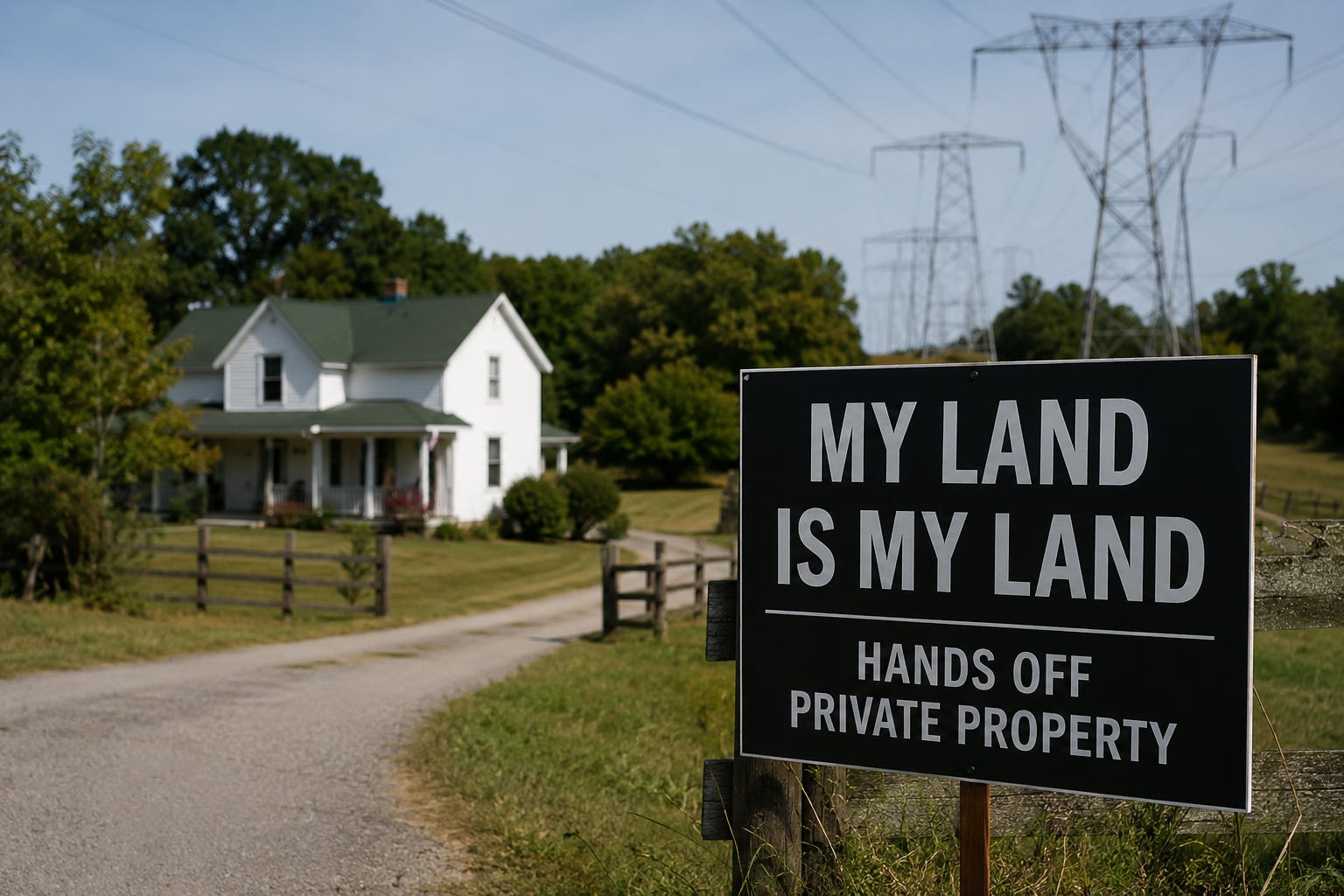
In Coweta County, Georgia, a young woman named Ansley Brown is watching her family home of more than twenty years get marked for a bulldozer.
Her home is not blocking a flood-control project. It is not standing in the way of a public road. It is in the path of a high-voltage transmission line Georgia Power wants to build to serve a massive private data center campus called Project Sail. Her family was told that if they did not settle on a price, Georgia Power could go to court and let a jury decide the value of the home they never wanted to sell.
Her family is not alone. Dozens of homes may be demolished, and more than 330 private properties are affected.
That is eminent domain in 2026. It is also theft.
If the government can take your land whenever someone more powerful wants it, then ownership is conditional, and conditional ownership is not ownership at all. If you cannot say no, it is not yours.
Some will say this view is too absolute. They will say roads will not be built, schools will not be constructed, and progress will stop if government loses the power to seize private land. That is a lie.
If a project is genuinely valuable, then the people who want to build it should pay enough to convince owners to sell. If they cannot, they should change the route, move the project, wait, or offer more. That is how free people deal with one another.
Walt Disney bought roughly 27,000 acres in Central Florida in the 1960s through voluntary transactions without taking a single acre by force. Private developers still assemble land every day for shopping centers, subdivisions, industrial parks, and major projects without forcing unwilling owners off their property. The claim that nothing can be built without eminent domain is not a fact. It is an excuse to avoid paying the real price.
Mississippi already understood this. In 2011, voters approved Initiative 31 by a landslide, 73 percent to 27 percent. The amendment barred the state and local governments from taking private property and transferring it to another private party for ten years after the seizure. The Mississippi Farm Bureau Federation led the fight. Governor Haley Barbour opposed it. The people won anyway.
But we left a hole.
Initiative 31 included an exception for “common carriers and utilities.” At the time, many voters likely understood “utility” to mean the power company serving the public. They did not imagine a utility using eminent domain to build a high-voltage corridor whose practical purpose is to serve one private data center. That loophole was written for one world. It is now being used in another.
This matters in Mississippi. Entergy and Mississippi Power both have legal authority to use eminent domain for transmission lines. I have seen no public reporting that either has threatened to use that power against a Mississippi landowner for a data center project. But the authority exists, and the pressure is growing. Mississippi is already seeing major data center development, including AWS-related transmission in Madison and Warren counties, Compass Data Centers in Meridian, and xAI in Southaven.
At some point, a utility may be tempted to use eminent domain to clear the way for infrastructure serving a private data center. Whether that happens should not depend on corporate goodwill. The power should not exist.
If Mississippi utilities ever use eminent domain against a farmer or homeowner to build a transmission line for a hyperscale data center, it will be no different in principle from what happened to Susette Kelo in New London or what is happening to Ansley Brown in Georgia. The state will be taking someone’s land for someone else’s profit.
The fix is simple. Mississippi voters should amend the Constitution again. This time, no loopholes. No exceptions. If a road, school, transmission line, or private development cannot be built without taking someone’s land by force, then the project should move, bend, wait, or pay enough to earn a voluntary yes.
A forced sale is not a free transaction.
My land is my land. The State of Mississippi is not my landlord. The Public Service Commission is not my landlord. Entergy is not my landlord. County supervisors are not my landlord.
Pay my price, change your plans, or go around.
But stealing my land is never OK.
Mississippi already understood this. In 2011, voters approved Initiative 31 by a landslide, 73 percent to 27 percent. The amendment barred the state and local governments from taking private property and transferring it to another private party for ten years after the seizure. The Mississippi Farm Bureau Federation led the fight. Governor Haley Barbour opposed it. The people won anyway.
This is pitiful really. And no surprise connected Haley opposed it.
I agree with you 100%