


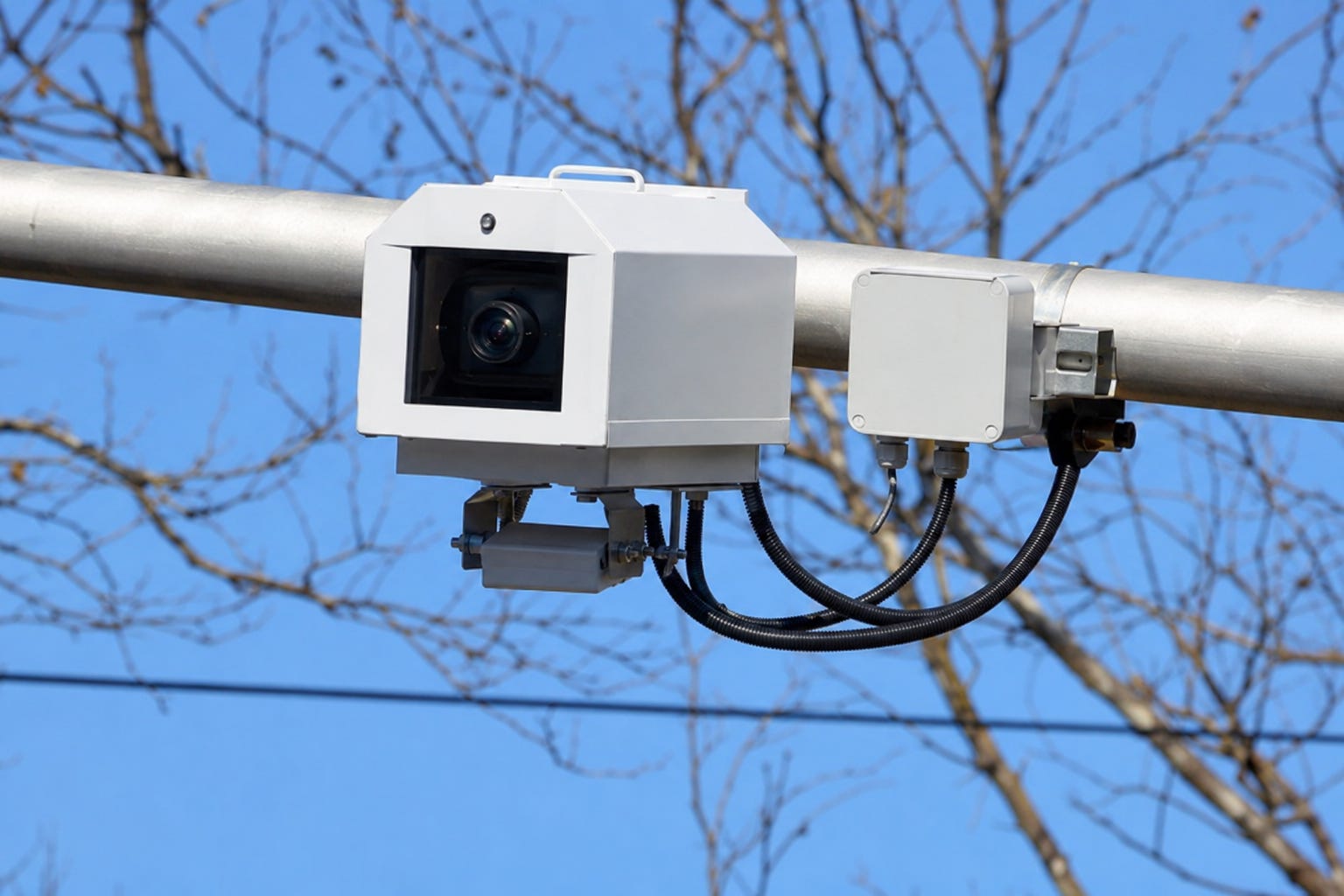
Mississippi has a new set of eyes on its roads — and most residents have no idea they’re coming.
The Mississippi Department of Information Technology Services Board quietly approved a contract last week with an Australian company called Acusensus to deploy AI-powered surveillance cameras on state roadways. The contract is worth $2,052,000 over three years, paid for entirely through federal grants. No legislative debate. No public vote. A board approval and a press release.
The Magnolia Tribune broke the story Thursday, and the details deserve a closer look.
What These Cameras Actually Do
Acusensus makes a product called Heads-Up. It is not a speed camera, and it is not a red light camera. It is something more sweeping than either.
The system works from mobile trailers that can be parked anywhere on the road network — left unattended for days or weeks at a time — and photographs every single vehicle that passes. Not vehicles it suspects. Not vehicles flagged by an officer. Every vehicle. The company’s own materials describe it as capturing “all traffic flow in the enforced lanes.” The AI then analyzes each image, looking simultaneously for a phone in a driver’s hand, an unbuckled seatbelt, a speeding vehicle, or an out-of-service registration.
When the AI flags a potential violation, it sends a real-time alert to a law enforcement officer waiting downstream. That officer then pulls your car over and issues a citation — for something he never personally witnessed.
The Mississippi Department of Public Safety’s own representative explained the process to the ITS Board: “The AI will actually capture it and send it downstream to an officer sitting downstream. The officer will determine if it is a valid violation for a stop and at that point the officer will actually stop the car and issue a citation in real-time.”
State Rep. Dan Eubanks (R) identified the constitutional problem immediately. “Every American citizen has a Constitutional right to face his or her accuser,” he said. “This begs the question, is that accuser some ambiguous AI positioned and aimed to stare into your vehicle... or the officer who didn’t physically witness the offense but is now writing you the ticket or making the arrest at the behest of that Artificial Intelligence?”
What Mississippi Law Currently Says
Before you accept the premise that these cameras are simply enforcing the law, it helps to understand what Mississippi law actually requires of drivers.
Mississippi banned texting while driving in 2015 — one of the last states in the country to do so. House Bill 389, signed by Governor Phil Bryant, prohibits writing, sending, or reading a text, email, or social media post on a handheld device while driving. The fine is $100. As of July 1, 2026, it counts as a traffic violation on your record rather than a civil penalty.
But here is the critical detail: Mississippi has no law against holding a phone. Talking on a phone while driving — phone held to your ear — is completely legal in Mississippi. The Legislature drew a deliberate line: texting is prohibited, holding the phone is not.
An AI camera cannot see that line. It sees a hand near a phone and flags it as a potential violation. It cannot distinguish between a driver who is texting — which is illegal — and a driver who is making a hands-free call with the phone resting in their hand — which is legal. The officer downstream receives an AI flag for behavior the camera cannot legally classify.
Mississippi Already Banned These Kinds of Cameras Once
This is not Mississippi’s first encounter with automated traffic enforcement. In 2009, the Legislature passed House Bill 1568 by a near-unanimous vote — 111-9 in the House, 42-9 in the Senate — banning counties and municipalities from using automated cameras to detect traffic violations. Governor Haley Barbour signed it into law. Jackson and Columbus, the two cities that already had red light cameras at the time, were required to remove them by October 1 of that year.
The 2009 law was a direct response to the same concerns now being raised about Acusensus: cameras issuing citations without an officer present, government revenue dressed up as public safety, and the fundamental question of whether automated enforcement belongs on public roads.
The Acusensus contract appears to sidestep that law on a technicality. The 2009 ban covers county and municipal governments — not state agencies. The Mississippi Department of Public Safety is a state agency. The trailer-based cameras also move constantly, arguably avoiding the “installed” standard in the law’s definition.
The letter of the 2009 law may not reach this contract. But its spirit could not be clearer.
The Question Mississippians Should Be Asking
Mississippi’s Legislature told cities they could not use cameras to enforce traffic laws. Seventeen years later, the state’s own agency has contracted to do exactly that — scanning every driver on targeted corridors, flagging potential violations by algorithm, and directing officers to make stops the officers never independently initiated.
House Ways and Means Chairman Trey Lamar said after learning of the contract that he expects the Legislature to investigate. That investigation is overdue and should happen before a single camera goes up.
This goes far beyond traffic tickets. Every driver is about to experience what we private (NOT Commercial) pilots are already dealing with: Persistent, continuous surveillance of every move our aircraft makes; every takeoff, every destination, every route taken, and every time a trip is taken is recorded by the government. This is 'guilty until proven innocent' writ large. Once you get 'conservative' enough, you make it back to the other 'end' of the circle, don't you?
Initially license plates had scrambled numbers and letters to make them difficult to remember, and thus track - epsecially for police - people _travelling_ in cars. And now here we are.
This travesty is so far beyond the purview of the government it is an outright aborgation of our founding principles which are:
Here's the basic premise in the founding of the Enlightenment Model of the US: Rights were given to you by your Creator, not by your government. Your government didn't give them to you so, they can't take them away. Furthermore the 9th Amendment to the Constitution makes these guarantees explicit. If any person in the government tries to take them away anyway, despite lacking any authority to do so, they are traitors to the citizens and must be treated as such.
A common misconception regarding the US government is that it is not the case that they start with total power and authority and the Constitution then subtracts from those powers. Under the Constitutional Principle of Enumerated Powers and despite common wisdom, the government actually starts with zero power. Powers are then granted (Enumerated) by the Constitution. This means that our Natural Rights such as the right to Privacy or the right to Free Speech do not need to be explicitly granted to the populace - we have them by default. (The Bill of Rights, while unnecessary, is a constant reminder of these exquisite qualities as well as an invaluable educational tool.) What it does mean is that the government cannot violate those rights unless the ability to do so is explicitly granted by the Constitution - which in those cases it is not.
That’s all there is to it. Not many things are more genius in their brevity—We hold all of the cards, they serve at our indulgence. Any power or action not explicitly granted by, We The People, the government cannot legitimately wield or execute. When they do so anyway, it is our civic duty to evict and convict them.
Every last person in the Federal Government works for us and signed a pledge to uphold the Constitution, and they’ve collectively, abjectly invalidated themselves by abrogating their duties, for breaking and trampling all over every oath of office, for committing every crime we have a law for, and for subjugating us—meaning we do not have legitimate leadership and instead have a bunch of criminals masquerading as our government.
For too long we've sat back, relaxed, and let the government police itself, and by doing so have given the wolves the keys to the hen house while naively expecting - in our blissful ignorance - for the Chickens to be in good hands...
Those Chickens have been and are being slaughtered, and the time has come for us to put those wolves in prison and to take back what is ours.
Despite what the government at every level wants badly for you to believe, you do not serve them. They serve you.