


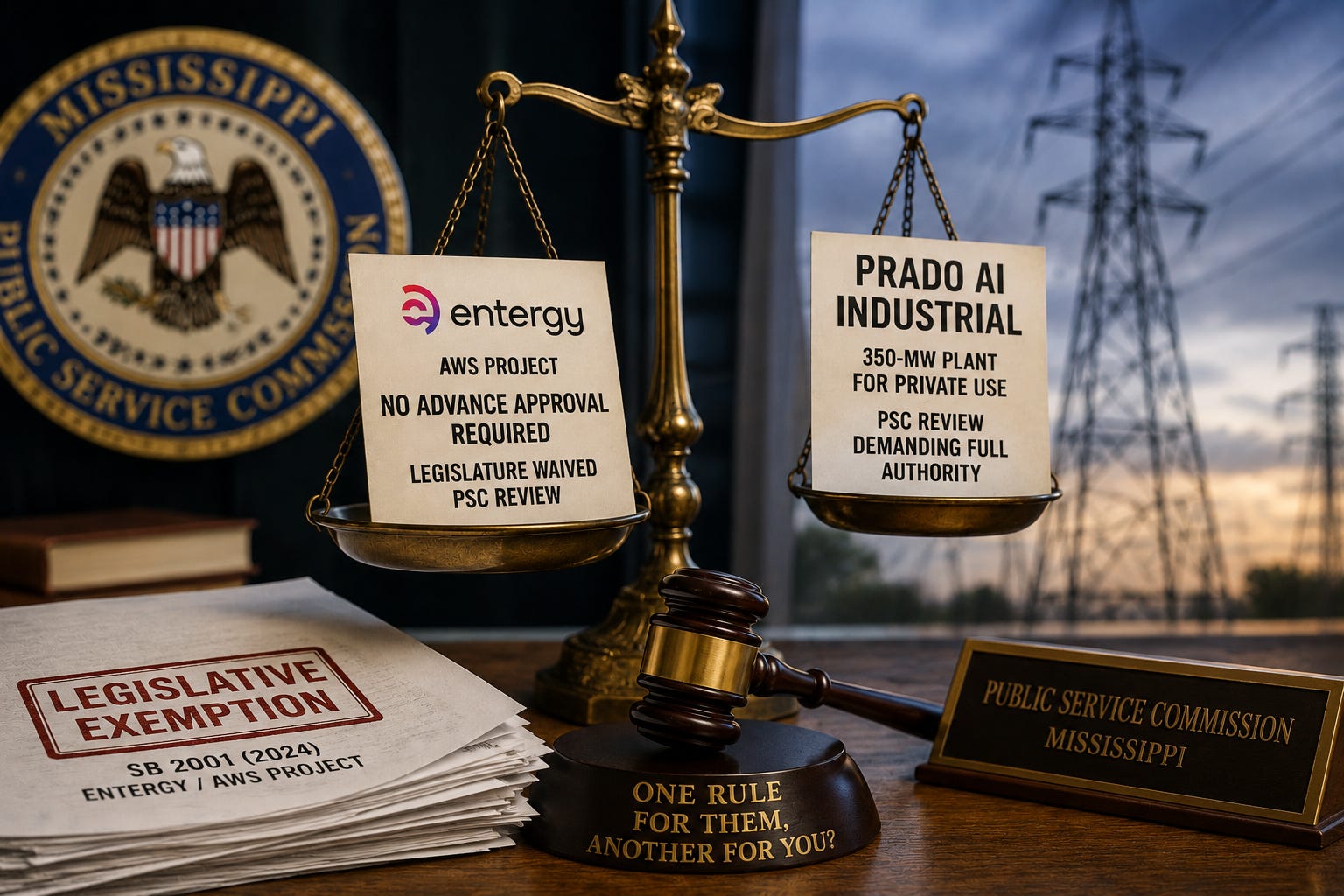
In January of 2024, the Mississippi Legislature voted in a special session to strip the Public Service Commission of its normal advance-approval authority over new electric generation, so that Entergy Mississippi could build power plants for Amazon Web Services without going through the standard regulatory front door. In April of 2026, Entergy and Mississippi Power are now asking that same Public Service Commission to use its full advance-approval authority to stop a competitor from building its own power plant for its own data center.
Same agency. Same statute. Two completely opposite requests. Both made in the favor of the same two established power companies.
If you want to understand what is wrong with the way Mississippi regulates this industry, you do not need to look any further than that pair of facts.
Start with what the legislature did in 2024. Senate Bill 2001 of the 2024 Second Extraordinary Session, signed by Governor Reeves on January 30 of that year, passed the Senate 49 to 1 and the House 120 to 2. Among other things, it authorized Entergy to build new power generating facilities tied to the AWS project without first obtaining the PSC’s normal Certificate of Public Convenience and Necessity. The PSC kept the authority to set rates and to review costs after the fact for prudence. But the upfront question of whether this generation should be built at all, and on whose dime, was taken off the PSC’s desk and handed to Entergy and the company they were building for. The justification at the time was that the standard process would slow the deal down and risk losing AWS to another state.
Now turn to 2026. In April, a Jackson-area developer named Gabriel Prado, the man behind the Fondren luxury apartments and the Topgolf in Ridgeland, filed Mississippi PSC Docket 2026-AD-10. He is asking the PSC for a declaratory opinion that he is not a public utility and does not need a Certificate of Public Convenience and Necessity to build a 350 megawatt natural gas plant in Ridgeland. The plant would exclusively power his own on-site project, a data center and an AI semiconductor fabrication facility. He is not proposing to sell power on the open market. He is not asking the State of Mississippi for a $44 million workforce training appropriation, a $215 million local infrastructure loan, or a 30 year rolling tax exemption. He is proposing to build it with private capital, on his own land, for his own use.
Entergy filed in opposition on April 13. Mississippi Power filed shortly after. Both companies argue that even though Prado would only be serving the tenants of his own campus, he should be classified as a public utility, because Ridgeland sits inside Entergy’s state certificated service area, where Entergy holds an exclusive right to sell power. They are leaning, according to Mississippi Today’s reporting, on a 2024 amendment to the Mississippi Public Utilities Act that expanded the definition of serving “the public” to explicitly include “an individual person or an entity or a collection of persons or entities.” In their formal filing, Entergy argues that whether Prado’s customers are “individual person(s) or an entity or a collection of persons … they meet the definition of the public.”
Read those two episodes side by side and the pattern is unmistakable. When the regulatory framework would have slowed AWS down, the legislature waived it. When the same regulatory framework can be deployed against a new entrant who would compete with the established utilities, those utilities are now invoking it. The agency in the middle, our Public Service Commission, is being asked to apply two different rules to two different developers, with the difference between them being which one is already on the inside.
That is not deregulation. That is not free market policy. That is exactly what the academic chapter by Garrett and Shughart in Promoting Prosperity in Mississippi calls “crony capitalism.” It is a regulatory framework that produces benefits for politically connected firms and costs for everyone who is not in the room when the rules are being written.
The Mississippi conservative position on this should not be complicated. Either the Public Service Commission has full advance approval authority over new electric generation tied to data centers, applied equally to Entergy, to Prado AI Industrial, and to anyone else who walks in the door, or it does not. Whichever rule we pick, it has to be the rule for everyone. Selective application of regulation, with the line drawn around who happens to already be a customer of the State of Mississippi’s economic development office, is the textbook definition of regulatory capture. Conservatives have been writing about its dangers since at least Adam Smith.
There is a clock on this. The PSC’s Public Utilities Staff is due to file its input in the Prado docket by May 15. The Commission has indicated it will issue its opinion by June 1. Mississippians who care about this should call our three elected commissioners and say it plainly: do not give Entergy one set of rules and Prado another. Apply the law equally.
If the PSC blocks Prado with rules the Legislature waived for Entergy, every Mississippi developer with private capital will hear the message clearly: do not bother. The deck is stacked.
That is not how a state attracts the next generation of investment. That is how a state protects the insiders, punishes the outsiders, and asks the rest of us to pay the bill.
Crony Capitalism!😡
Good writing. No completion means higher costs for the public consumers.