


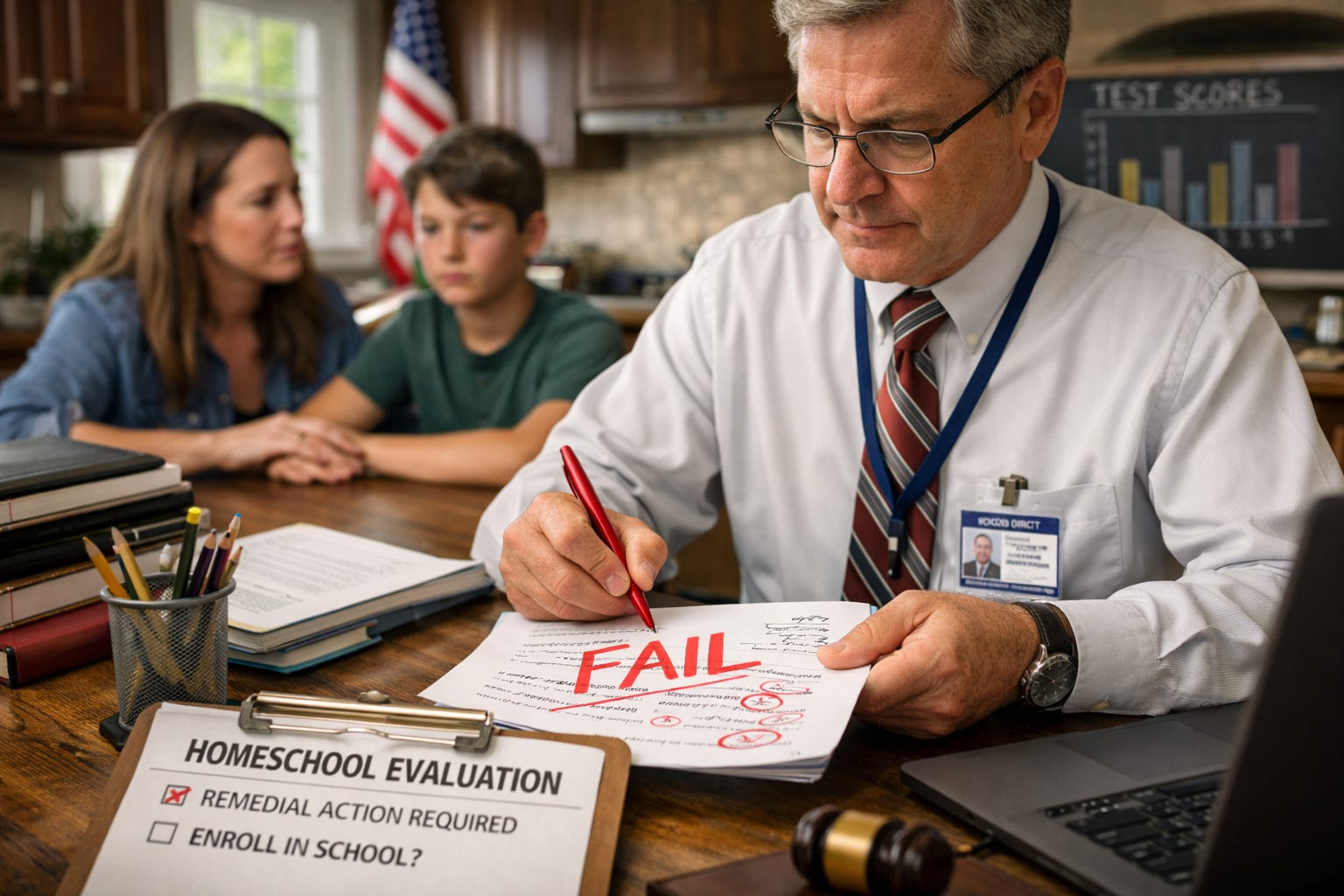
Picture a school official sitting at your kitchen table, red pen in hand, grading not just your child’s test but your decision to homeschool at all. That is the direction Tennessee is headed if HB1729 becomes law.
HB1729 is being sold as a minor update to testing rules and a chance to add one more exam option, the Classic Learning Test (CLT). But behind the technical language lies a clear shift: more state control over home education and less trust in parents.
Here’s what the bill really does. It expands mandatory standardized testing for homeschool students in grades 5, 7, and 9. Those test scores would no longer be just between parents and their children. HB1729 requires that results be sent to the local director of schools and the state board, feeding more data into government systems and inviting more scrutiny of families who have chosen a different educational path.
The bill also redefines what counts as “non‑proficient” with detailed cut scores and percentiles. If a child’s performance falls below those rigid thresholds, parents are automatically pulled into mandated consultations with district officials and licensed teachers — people who may never have met the student, but now gain leverage over what is deemed an “acceptable” homeschool education.
If the student still doesn’t hit the state-approved numbers, HB1729 forces a second round of the same standardized test within a year. That happens regardless of whether the parents believe the test is appropriate, accurate, or aligned with their curriculum or their child’s learning style. Home instruction, in effect, becomes a probationary program, subject to recurring state evaluation.
Most troubling, the bill authorizes the director of schools to order parents to enroll their child in a public, private, or church-related school if the student repeatedly underperforms and is not diagnosed with a learning disability. In other words, one official, using one narrow measurement, could overrule a family’s educational choice.
That is a profound shift in who ultimately decides what is best for a child.
Standardized tests can be useful tools, but HB1729 turns them into gatekeepers of educational freedom. It assumes that a single test score on a few days out of a year should carry more weight than years of daily parental observation, tutoring, and instruction. It treats parents as suspects who must prove their competence to the state rather than as partners trusted to raise and educate their own children.
Yes, the bill does one positive thing: it recognizes the CLT, slightly expanding options for both public and homeschool students. But this small gain is chained to a larger expansion of regulatory burdens and surveillance. That is a bad trade for Tennessee families and for anyone who believes in limited government.
Homeschooling parents are already accountable — to their children, to their own consciences, and ultimately to the same laws that protect every child from neglect or abuse. HB1729 layers on a new regime of testing, reporting, and potential coercion that undermines that accountability rather than improving it.
Lawmakers should reject HB1729, and citizens should tell them so. Call your representative, attend local meetings, and speak up: Tennessee does not need more centralized control over education. It needs more trust in families.
Live in Tennessee?
Go to Tennessee Stands and Take Action.
NO to this bill.