


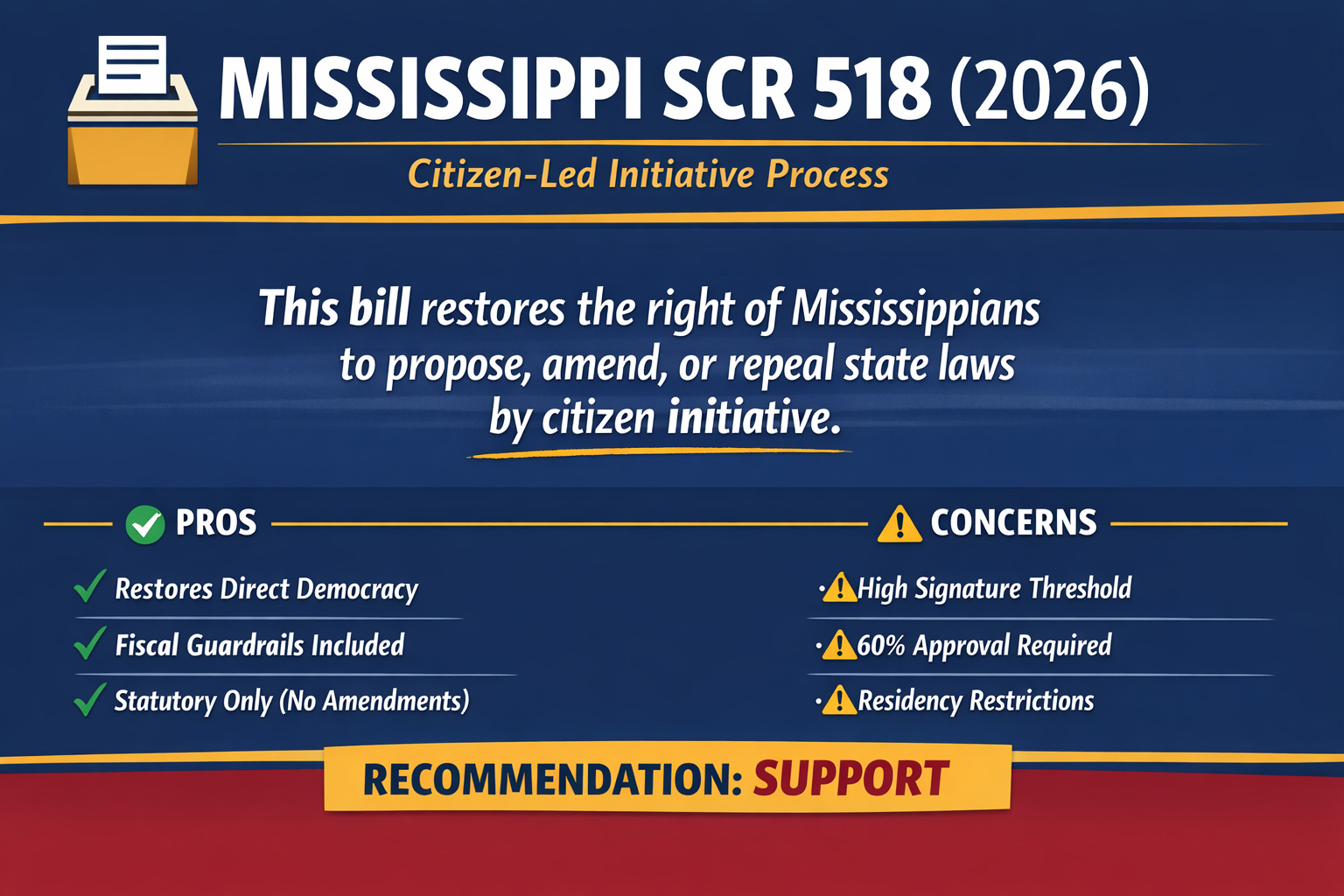
This bill proposes a Mississippi constitutional amendment to let voters propose, amend, or repeal state statutes by citizen initiative and approve or reject them at the ballot, subject to procedural and subject-matter limits.
Bill basics
Vehicle: Senate Concurrent Resolution (constitutional amendment)
Election date: November 2026 general election
Committees/Referral: Elections
What it changes: Amends Sections 33, 56, 61, and 72 of the MS Constitution to create an initiative process for statutes (not constitutional provisions).
Key provisions
Creates initiative power for statutes: People can propose new laws or amend/repeal existing laws by petition and election, independent of the Legislature.
Limits what initiatives can do: No initiatives for:
Constitutional amendments (must go through the constitutional process)
PERS laws
Local or special laws
Subjects the Constitution bars the Legislature from enacting
Measures that “deprive” a human being (as defined in statute) of the right to life
Ballot access rules:
Signatures equal to 10% of active registered voters collected over 12 months
33-1/3% cap from any single congressional district
SOS decides sufficiency, with MS Supreme Court original/exclusive jurisdiction for challenges
Fiscal guardrails: Sponsors must identify revenue sources; if substantial cost/expenditure, must provide a funding mechanism; cannot redirect funds from one agency to another; cannot require deficit spending.
Voting thresholds:
Generally: majority approval and at least 40% of total votes cast in that election
If “substantial cost” initiative: majority approval and at least 60% of total votes cast
Legislative involvement option: Legislature may adopt or amend; if amended, voters see both versions.
Governor: Initiatives are not subject to gubernatorial veto and do not require signature.
Two-year lock: No substantive legislative amendment/repeal for 2 years, unless extenuating circumstances and 3/5 vote of each chamber.
Liberty analysis
Pros (liberty-aligned)
Checks the political class: Creates a direct mechanism for citizens to override entrenched interests and legislative inaction, consistent with a decentralizing, anti-cartel view of government power.
Built-in fiscal restraint features: Requiring funding identification, restricting deficit spending, and higher thresholds for costly measures reduces the risk of pure “ballot-box budgeting.”
Statutory-only initiative: Keeping constitutional amendments off-limits prevents frequent, shifting constitutional policy via campaigns.
Cons (liberty risks)
Majoritarian risk: Initiatives can still be used to expand government, regulate, or tax through emotional campaigns and low-information elections.
Process restrictions: The in-state residency requirement for petition circulators and the cap by congressional district can be viewed as participation constraints (even if justified as anti-fraud measures).
Two-year lock-in: Can entrench bad policy temporarily if a poorly drafted initiative passes.
Recommendation
Support
Where do you stand on this?