


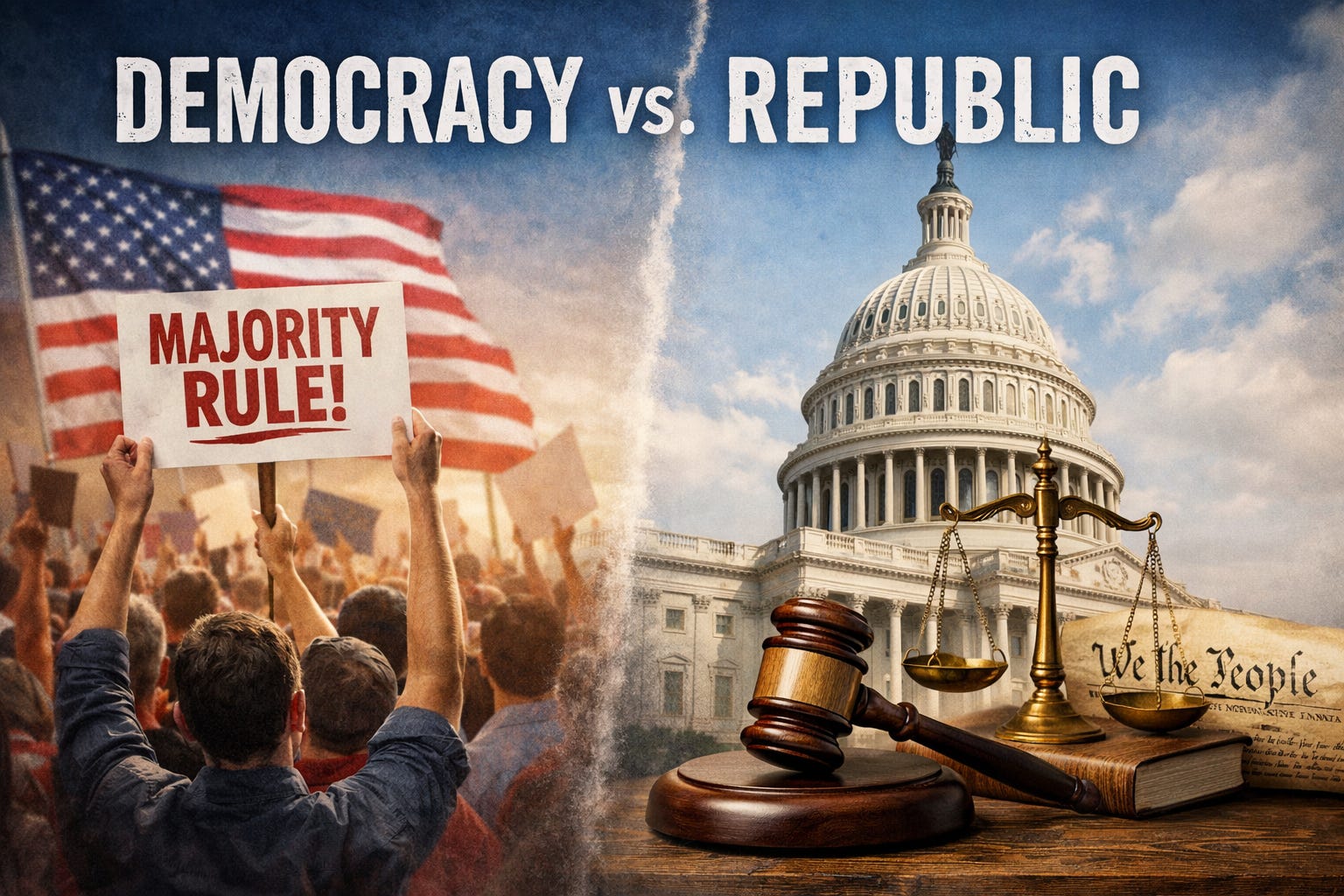
Americans are often told they live in a democracy. The word is used as a synonym for freedom, fairness, and self-government. But strictly speaking, the United States was never designed to be a pure democracy. It is a representative republic, and that distinction is not semantic trivia. It is the foundation of why the system has endured.
In a true democracy, citizens vote directly on laws and policies. Every issue is decided by majority rule. While this may sound ideal in theory, it comes with a serious flaw: the majority is not restrained. If 51 percent of voters want something, they get it, even if it violates individual rights, harms minorities, or creates long-term instability.
A representative republic works differently. Citizens elect representatives to make laws on their behalf, within a framework constrained by a constitution. Those representatives are accountable to voters, but they are also bound by limits on government power, separation of powers, and protections for individual rights. The goal is not just to reflect public opinion, but to filter it through deliberation, law, and constitutional restraint.
The Founders understood the danger of unchecked majority rule. James Madison warned that democracies “have ever been spectacles of turbulence and contention” and were often short-lived. History backs him up. Pure democracies are vulnerable to emotional swings, demagogues, and policies driven by passion rather than principle. When decisions are made by immediate popular vote, there is little incentive to consider long-term consequences or the rights of those who disagree.
One major problem with a true democracy is the risk of majority tyranny. If the majority can vote itself benefits at the expense of others, higher taxes on a minority group, restrictions on unpopular speech, or confiscation of property, there is no built-in safeguard to stop it. A representative republic, by contrast, places certain rights beyond the reach of a simple majority. Free speech, due process, property rights, and equal protection are not supposed to be up for a vote.
Another problem is instability. Constant direct voting on complex issues leads to rapid policy swings and shallow decision-making. Most citizens do not have the time or resources to deeply study every issue of governance. Electing representatives allows voters to choose people whose job is to specialize, deliberate, and negotiate, while still being removable if they fail.
A representative republic also slows down bad ideas. That is not a bug; it is a feature. Requiring legislation to pass through multiple bodies, survive debate, and comply with constitutional limits prevents momentary outrage or fear from becoming permanent law.
Calling America a democracy may be politically convenient, but it misses the point. The country’s strength lies not in raw majority rule, but in a system designed to balance popular consent with liberty, stability, and restraint. A representative republic recognizes a hard truth: the purpose of government is not merely to do what the majority wants today, but to protect freedom for everyone tomorrow.