


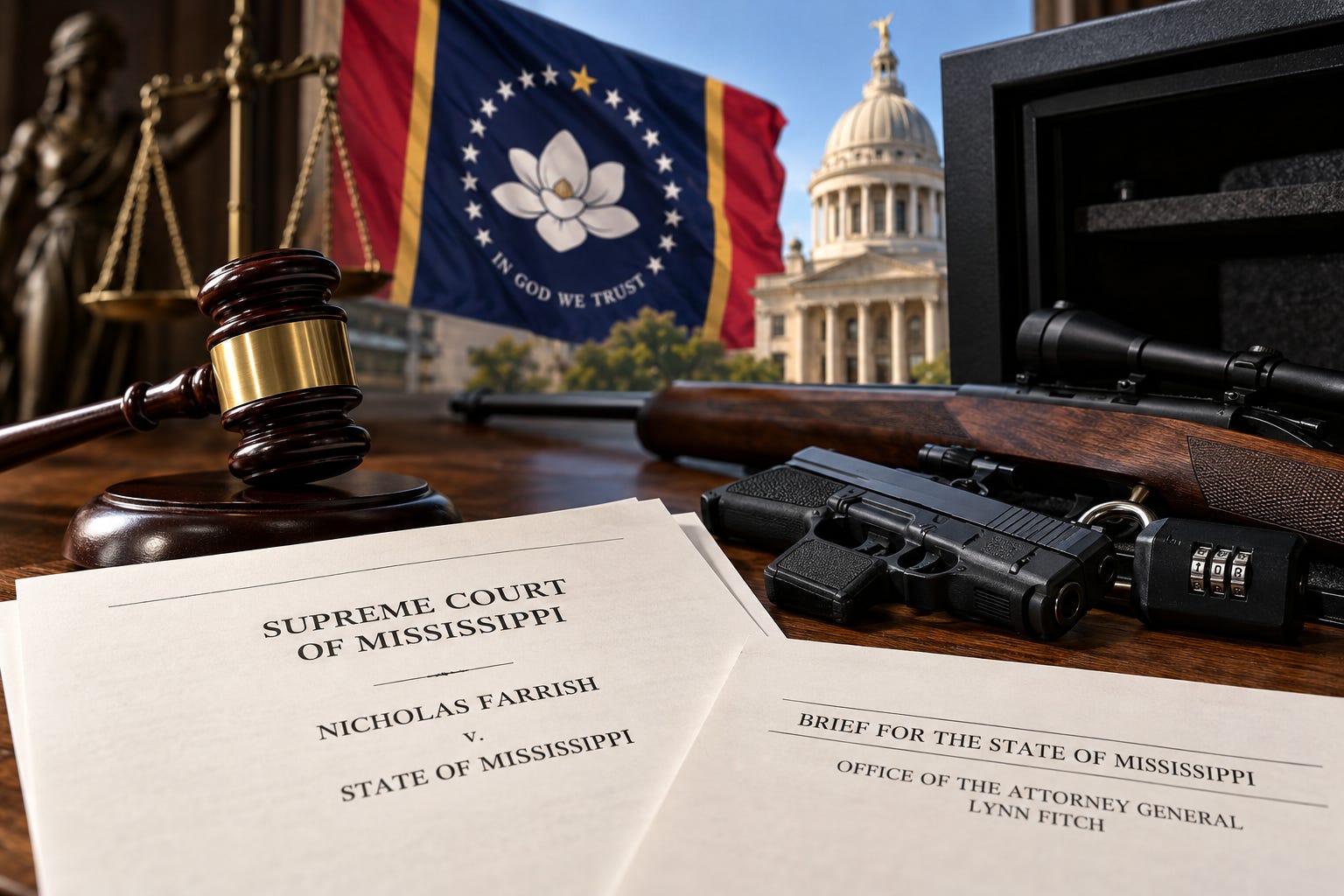
Nicholas Farrish did exactly what the law tells people in his position to do. After a felony conviction, he served his sentence, finished his supervision, and rebuilt his life. Then he asked a Mississippi court to restore the firearm rights his conviction had stripped away, a path the statute itself lays out.
What happened next should give every Mississippian pause. A circuit judge weighed the evidence and found, in writing, that Farrish is fully rehabilitated and that his possessing a firearm “would not be dangerous to public safety.” That is not a hunch or a technicality. It is a judicial finding, made after a hearing.
And then the same judge gave him back only part of what he had asked for. Long guns, yes. A handgun, no. And whatever firearm he does keep must sit locked in a safe whenever it is not in his hands.
Think about what this means. The only justification for disarming a citizen is the threat they pose to public safety. Taking their guns protects the community. But the State concedes there is no danger here. A judge found this man safe, and the State does not dispute it. Once the danger is gone, so is the reason.
Yet the State still claims the power to tell a man, it admits is harmless, which guns he may own, long guns, yes; a pistol, no, and to make him lock the rest in a safe inside his own home. If he is safe, he is safe with a handgun too; the risk is in the person, not the type of gun. This is not public safety. This is the government treating a constitutional right as a privilege, arbitrarily granting it to citizens as it pleases.
Farrish’s felony was a third DUI. Drunk driving kills, it shatters families, and Mississippi is right to treat it as a grave offense. But Farrish is not a predator, and the judge who heard every fact of it found he poses a danger to no one.
Most of us have never really thought this through. We hear “convicted felon” and we nod when the government takes the guns away. It feels like plain common sense. But look closer. We are not talking about arming someone a court believes is dangerous. We are talking about a specific man a court found safe and a government that still refuses to fully let go.
This is no longer an abstract debate. Farrish’s case is now before the Mississippi Supreme Court, and Attorney General Lynn Fitch’s office has just filed the State’s brief. I have read all thirty-two pages. Fitch’s lawyers argue that a convicted felon, any convicted felon, has no Second Amendment right in the first place. They argue the courts need not even ask whether a particular person is actually dangerous. And they defend the lock-and-key order on a man already found rehabilitated as a perfectly reasonable condition.
Nowhere in those thirty-two pages does Fitch’s brief cite the Mississippi Constitution, which guarantees the right of “every citizen” to keep and bear arms.
Here is the uncomfortable truth the case lays bare. A right the government can switch off for an entire class of people and leave off even after a judge rules the danger gone is not really a right at all. It is a privilege, handed back when the state decides it feels like it.
Farrish served his time. A judge said he is safe. The only question left is whether “shall not be infringed” still means something in Mississippi, or whether our rights now come with a combination lock.
I agree with you know one should get a life sentence for a none valiant crime
Did the judge give him back his voting rights? Should he get them back, too, or should that be permanent punishment?